How Half-Halts Improve Every Ride
September 19, 2026
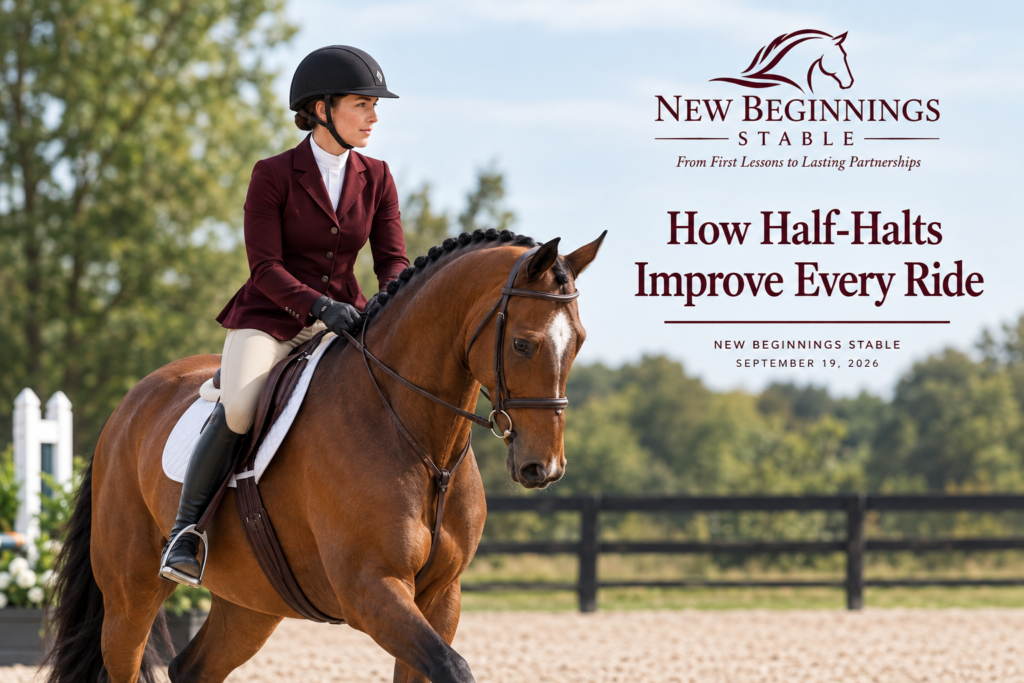
Small Adjustment. Big Difference.
One of the most useful tools in riding is also one of the easiest to misunderstand: the half-halt.
I talk about half-halts with my riders all the time because they can improve almost every part of a ride—from the flatwork to the jumping course.
A half-halt isn’t about pulling your horse backward. It isn’t about stopping. And it isn’t something you only use before a jump.
A good half-halt is a way of saying to your horse:
“Pay attention. Get balanced. Stay with me. We’re about to do something.”
When the horse understands that communication, the entire ride can become more organized.
What Exactly Is a Half-Halt?
A half-halt is a brief combination of your seat, leg, and rein aids that asks your horse to rebalance and become more attentive without losing forward movement.
Think of it as a reset.
Your horse may be moving along correctly, but perhaps he is getting a little heavy in your hands, losing his balance, drifting through a turn, or becoming distracted.
A half-halt can help bring his attention back to you.
The important part is that the half-halt should not stop the forward movement.
I want my riders to think:
Balance without losing impulsion.
That’s the goal.
Why Half-Halts Matter So Much
A horse doesn’t automatically know what we want to do next.
As riders, we need to communicate before we make a change.
Maybe we’re approaching a corner.
Maybe we’re preparing for a transition.
Maybe we’re riding toward a jump.
Maybe we’re changing direction.
A well-timed half-halt gives the horse a moment to organize himself before the next movement.
This is especially important in Hunter/Jumper riding because we want our horses to be adjustable without becoming tense.
We want the horse listening, balanced, and ready.
Half-Halts Start With Your Seat
One of the biggest mistakes I see is riders trying to create a half-halt primarily with their hands.
That’s not where I want the communication to start.
Your seat and body position are important parts of the conversation.
Sit tall.
Stay balanced over your horse’s center of gravity.
Close your leg to maintain the forward energy.
Then use your rein connection briefly to help the horse rebalance.
The exact amount of pressure will depend on the horse.
Some horses respond to a very subtle adjustment. Others need a clearer aid.
The goal isn’t to pull harder.
The goal is to make the communication clearer.
Half-Halts and Transitions
Transitions are one of the best places to practice half-halts.
Before asking for a downward transition, a half-halt can help your horse prepare.
Before asking for an upward transition, it can help your horse become attentive and balanced.
For example, if you’re moving from trot to canter, you don’t want to simply kick and hope for the best.
Prepare first.
Sit.
Organize the rhythm.
Use your half-halt.
Then ask for the transition.
The result should be a horse that understands the request rather than a horse that is surprised by it.
Half-Halts Improve Turns
Turns are another area where half-halts can make a huge difference.
As you approach a corner or turn, your horse needs to stay balanced.
Without preparation, a horse may fall onto the inside shoulder, drift outward, or lose the rhythm.
A properly timed half-halt can help keep the horse’s attention on the rider while maintaining the forward energy needed to complete the turn.
This becomes especially important when riding a course.
Every turn is an opportunity to prepare for what comes next.
Half-Halts Before the Jump
Half-halts are particularly valuable before a fence.
But again, the goal isn’t to slow the horse down simply because a jump is coming.
Instead, I want the horse to become more balanced and adjustable.
As we approach a jump, I need to know that I can influence the horse’s stride.
Can I ask for a little more?
Can I ask for a little less?
Can I maintain the rhythm?
Can I keep the horse straight?
A good half-halt helps answer those questions.
It gives me a way to communicate with my horse without disrupting the rhythm we’ve worked so hard to establish.
That’s one reason I emphasize correct flatwork so much.
The better your horse responds to your aids on the flat, the easier it becomes to communicate over fences.
Don’t Overuse Them
Like any riding aid, half-halts can be overused.
If you are constantly pulling on the reins, your horse can become dull to the aid.
Instead of listening, the horse may simply learn to wait for the next pull.
That’s not what we want.
A half-halt should be brief, purposeful, and followed by a release.
Ask.
Allow the horse to respond.
Then continue riding.
Your horse should learn that when you give a half-halt, something is being communicated—not that you’re going to hold him back indefinitely.
Practice Without Jumping
You don’t need to jump a single fence to improve your half-halts.
In fact, I prefer riders to develop this skill on the flat first.
Try practicing them:
- Before transitions
- Before and after corners
- On circles
- Before changes of direction
- When adjusting the pace
- Before moving from trot to canter
- Before returning to trot
- Down the long side of the arena
- Before approaching ground poles
Pay attention to what happens.
Does your horse become more attentive?
Does he rebalance?
Does the rhythm stay consistent?
Does he respond without becoming tense?
Those are the things I’m looking for.
The Goal Is Better Communication
At its core, riding is communication.
We aren’t trying to control every stride of the horse’s body.
We’re developing a partnership where the horse understands our aids and becomes responsive to them.
The half-halt is one small part of that conversation, but it is an incredibly useful one.
When riders learn to use half-halts correctly, I often see a noticeable difference in their entire ride.
The horse becomes more attentive.
Small Aid, Big Results
Transitions become smoother.
Turns become more balanced.
Distances become easier to manage.
And jumping rounds become more organized.
Most importantly, the rider starts to feel more connected to the horse.
That’s what I’m looking for when I teach.
Not just a rider who can get around the arena, but a rider who understands why something works and can communicate with their horse more effectively.
You don’t need a dramatic movement to make a meaningful change in the saddle.
Sometimes the smallest adjustments have the biggest effect.
A well-timed half-halt can prepare your horse for what’s coming, improve balance, maintain rhythm, and make your communication clearer.
So the next time you’re riding, don’t think of the half-halt as something you use only when something goes wrong.
Think of it as a conversation before the next step.
Prepare your horse.
Keep the rhythm.
Stay balanced.
And then allow your horse to move forward.
Good riding isn’t about doing more. It’s about communicating better.
At New Beginnings Stable
At New Beginnings Stable, I believe strong Hunter/Jumper riding starts with understanding the fundamentals. When horse and rider learn to communicate clearly, the result is greater confidence, better balance, and a stronger partnership.
Whether you’re working on your first transitions or preparing for your next course, the basics matter.
From First Lessons to Lasting Partnerships.