Straightness: The Secret Ingredient to Better Courses
September 8, 2026
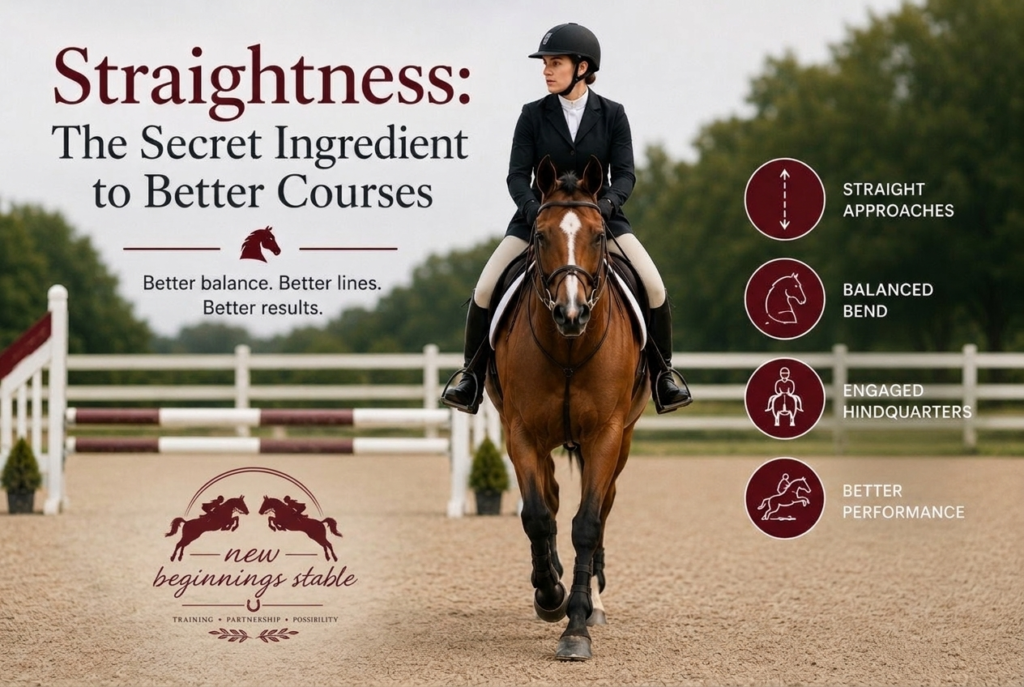
Straightness is one of the most overlooked fundamentals in Hunter/Jumper riding. Learn how proper alignment, balance, and riding lines can create smoother approaches, better distances, and more confident jumping rounds.
When riders think about improving their jumping, they often focus on the jump itself.
They think about the distance, the height, the takeoff, or whether their horse will make it over the fence.
But sometimes the problem starts much earlier.
One of the most overlooked fundamentals in Hunter/Jumper riding is straightness.
A horse doesn’t have to be traveling in a perfectly straight line every second of a ride. We use bend, turns, circles, and changes of direction constantly.
What matters is that the horse is correctly aligned with the direction we are asking it to travel.
When the horse is straight, everything becomes easier.
The turns become smoother. The distances become more predictable. The horse can use its body more effectively. And the rider has a much better chance of producing the organized, balanced round we’re looking for.
What Does Straightness Really Mean?
Straightness means that the horse’s body is properly aligned from front to back.
Ideally, the shoulders, rib cage, and hindquarters are working together rather than different parts of the horse drifting in different directions.
This sounds simple, but horses naturally have a tendency to be crooked.
Just like people, horses have stronger and weaker sides. They may want to drift toward one shoulder, fall out through a turn, or allow their hindquarters to swing away from the path.
The rider’s job is to recognize those tendencies and develop better balance and control.
Why Straightness Matters Before the Jump
A lot of riders think a missed distance happens at the jump.
Often, it actually starts several strides earlier.
Imagine you’re approaching a vertical and your horse’s shoulder is drifting slightly to the outside.
You may still feel like you’re riding toward the center of the fence, but your horse isn’t truly traveling straight.
Now you’re getting closer to the jump.
The horse has less room to organize its stride.
The rider reacts by changing the pace or adjusting the reins.
Suddenly, the distance doesn’t feel right.
The rider may think, I missed my distance.
But the real problem may have started with the line.
Straight approaches create better opportunities for good distances.
That’s one reason I spend so much time teaching my riders to pay attention to the entire line—not just the final few strides before a fence.
Straightness Makes a Hunter Round Look Better
In the Hunter ring, straightness is especially important.
Hunters are expected to look smooth, organized, and confident.
A horse that drifts through turns or wanders toward a fence can make an otherwise good round look less polished.
When the horse is straight and balanced, the rider doesn’t have to make as many obvious corrections.
The result is a quieter, more effortless-looking ride.
And that’s what we’re trying to achieve.
We don’t want the rider fighting to keep the horse on the track.
We want the horse and rider working together.
Your Legs Do More Than Your Hands
One of the biggest lessons I teach riders is that straightness isn’t created by constantly pulling on the reins.
Your legs, seat, and eyes are extremely important.
If your horse wants to drift right, your left leg may need to help maintain the correct line. Your outside rein can help support the shoulder, while your seat helps communicate where you want the horse’s body to go.
This takes practice.
Riders sometimes try to fix crookedness by using more rein.
Usually, that creates another problem.
Instead, I want riders to think about guiding the horse’s entire body, not simply pointing the nose in the right direction.
Exercises That Improve Straightness
You don’t need to jump a course to work on straightness.
Some of the best exercises can be done entirely on the flat.
Ground Poles
Ride over poles while concentrating on maintaining a straight approach and straight departure.
Don’t just look at the pole.
Look where you want to go afterward.
The Centerline
The centerline is one of my favorite tools for teaching straightness.
Ride down the centerline and pay attention to whether your horse stays centered.
Is the shoulder drifting?
Are the hindquarters moving sideways?
Are you sitting evenly?
These small observations can teach you a lot.
Circles and Transitions
Circles help develop balance, while transitions teach the horse to respond to the rider’s aids.
Try maintaining the same quality of movement before, during, and after the transition.
The goal isn’t simply to change gaits.
The goal is to remain balanced while doing it.
Straight Lines
Ride from one point to another without allowing the horse to drift.
This sounds easy until you really start paying attention.
Choose a destination and ride directly toward it.
Your eyes should be looking ahead rather than constantly checking the horse’s head.
Straightness Creates Confidence
One of the best things about improving straightness is that it creates confidence for both horse and rider.
The rider knows where they’re going.
The horse understands the line.
The approach becomes more predictable.
And when the approach is predictable, the jump becomes less intimidating.
This is especially important for riders who are still developing their confidence.
I don’t want my riders thinking that every jump requires a last-second correction.
I want them to understand that good jumping begins with good preparation.
Better Courses Start With Better Basics
Straightness may not be the most exciting topic in Hunter/Jumper training.
It’s not as flashy as jumping a big fence.
But good straightness can make a tremendous difference in the quality of a course.
When the horse is balanced and traveling correctly, the rider can concentrate on the bigger picture—rhythm, pace, turns, distances, and the overall flow of the course.
That’s when jumping starts to feel easier.
And that’s the goal.
At New Beginnings Stable, I want riders to understand why something works—not simply memorize what to do.
The more educated the rider becomes, the better decisions they can make in the saddle.
So the next time you ride a course, don’t just ask yourself whether you found the distance.
Ask yourself:
Was my horse truly straight on the approach?
You may discover that the answer changes more about your jumping than you expected.