The Importance of Rhythm Before Height
September 8, 2026
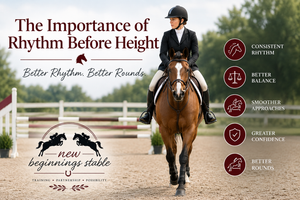
Before you raise the jumps, improve the rhythm. Learn why consistent pace, balance, and communication create better jumping rounds for both horse and rider.
Better Rhythm. Better Rounds.
One of the biggest mistakes I see riders make when they are learning to jump is thinking that progress means jumping higher.
It doesn’t.
In my experience, riders often improve much faster when they stop worrying about height and start focusing on rhythm.
A good jumping round begins with a horse and rider moving together in a consistent, balanced rhythm. Before we worry about how high the jump is, I want my riders to learn how to create that rhythm, maintain it, and trust it.
What Is Rhythm?
Rhythm is the regular, consistent cadence of your horse’s stride.
It isn’t the same thing as speed.
A horse can be moving quickly without having a good rhythm, just as a horse can be moving slowly without being balanced. What we want is a pace that allows the horse to move comfortably, stay balanced, and remain responsive to the rider.
Think of it like a song. The beat should remain consistent even when the music changes.
The same thing should happen in a jumping course.
Your horse should be able to maintain a similar rhythm through the turns, down the lines, between the jumps, and after landing.
Why Rhythm Matters More Than Height
When a rider is focused on jumping higher, it is easy to become tense or rush the approach.
The rider may start pushing the horse toward the jump, chasing the distance, or changing the horse’s stride in the last few steps.
That’s when things can begin to unravel.
A horse that approaches a jump in a balanced rhythm has a much better opportunity to jump well. The horse can see the obstacle, organize its body, and use its stride appropriately.
The rider’s job isn’t to manufacture the jump.
The rider’s job is to create the conditions that allow the horse to jump successfully.
That’s why I would much rather see a rider produce a beautiful, consistent round over smaller jumps than struggle around a course simply because the jumps are bigger.
Bigger Isn’t Always Better
There is nothing wrong with wanting to progress to higher jumps. That’s part of the sport, and reaching new goals can be incredibly rewarding.
But height should be a result of good training, not the goal of every ride.
When the basics are solid, increasing the height of the jumps becomes much easier.
When the basics aren’t solid, increasing the height simply makes the existing problems more obvious.
If your horse loses rhythm approaching a small vertical, making the vertical bigger isn’t going to fix the problem.
We need to go back and improve the rhythm.
That might mean working on transitions, adjusting the pace, improving the rider’s position, or simply spending more time developing confidence and consistency on the flat.
Rhythm Builds Confidence
One of the most important things I want my riders to understand is that confidence comes from preparation.
When you know your horse is listening to you, when you can maintain your rhythm, and when you know how to organize your horse before a jump, you have something to rely on when the course becomes more challenging.
Your horse also notices when you become nervous.
If you suddenly change your pace, grip with your legs, pull on the reins, or lean forward because you’re worried about the jump, your horse can feel that change.
A consistent rhythm helps both horse and rider stay relaxed and focused.
Practice Rhythm Without Jumps
You don’t need a full course of jumps to improve your jumping.
In fact, some of the most productive jumping exercises don’t involve jumping at all.
Spend time working on:
- Consistent walk, trot, and canter transitions
- Maintaining the same pace around the arena
- Large and small circles
- Straight lines
- Changes of direction
- Transitions within the gait
- Keeping your horse responsive to your leg and seat
- Maintaining balance through turns
Then, when you add a jump, your horse already understands the rhythm you’re asking for.
The jump simply becomes another part of the exercise.
Let the Jump Come to You
One of the hardest things for riders to learn is that they don’t need to rush the jump.
If your rhythm is correct, your horse is balanced, and you’re riding forward with confidence, you can allow the jump to come to you.
This doesn’t mean becoming passive.
You still need to ride.
You need to maintain your pace, keep your horse straight, support the turn, and make adjustments when necessary. But you don’t want to spend the final few strides chasing a distance that isn’t there.
Trust the work you’ve done.
Trust your horse.
And trust your rhythm.
Progress Takes Patience
Every horse and rider combination develops at a different rate.
Some riders gain confidence quickly. Others need more time. Some horses naturally have a beautiful rhythm, while others need training to develop consistency and balance.
That’s okay.
My goal isn’t to make every rider jump the biggest jump in the arena.
My goal is to develop confident, educated riders who understand what they are doing and why they are doing it.
When the rhythm is correct, the horse is balanced, and the rider is communicating clearly, jumping becomes much more natural.
And that’s when we can start talking about bigger goals.
So the next time you’re tempted to raise the jump, ask yourself a different question:
Can I keep the same beautiful rhythm from the first stride to the last?
If the answer is yes, you’re building the foundation for better jumping—and that’s progress worth celebrating.
At New Beginnings Stable
At New Beginnings Stable in Canton, Georgia, we focus on developing strong fundamentals, confident riders, and better horse-and-rider partnerships. Whether you’re beginning your riding journey or working toward your next Hunter/Jumper goal, correct basics are where lasting progress begins.
From First Lessons to Lasting Partnerships.